



Water Quality Sampling and Data Management for Emerging Contaminants Program
Client
New Mexico Environment Department
Markets
Challenge
Per- and polyfluoroalkyl substances (PFAS) have become a concern in the environment, due to the potential adverse health effects that have been associated with these chemicals. Products containing PFAS have been widely used for decades in products used for firefighting, non-stick cookware, stain-resistant materials, food packaging, shampoos, and other uses. Studies have shown that exposure to PFAS raises risks for cancer, liver damage, human development problems, and other long-term or fatal conditions. Often called “forever chemicals” because they break down slowly, if at all, PFAS can seep into soil, surface water, and groundwater. In recent years, PFAS and other newly identified contaminants of concern have been targeted for study as “emerging contaminants.” Of particular concern is the safety of water quality in public water systems.
Solutions
To investigate New Mexico public water systems, the New Mexico Environment Department’s Emerging Contaminants Program (NMED ECP) has received funding from the U.S. Environmental Protection Agency (EPA). The Emerging Contaminants in Small or Disadvantaged Communities Grant is supporting the ECP in a 2-year study of more than 650 water systems statewide. Geo-Logic Associates (GLA) has been contracted to sample drinking water at each of these public water systems. Depending on the type of system, GLA technicians are collecting 2 to 4 samples at various times within a one-year period.
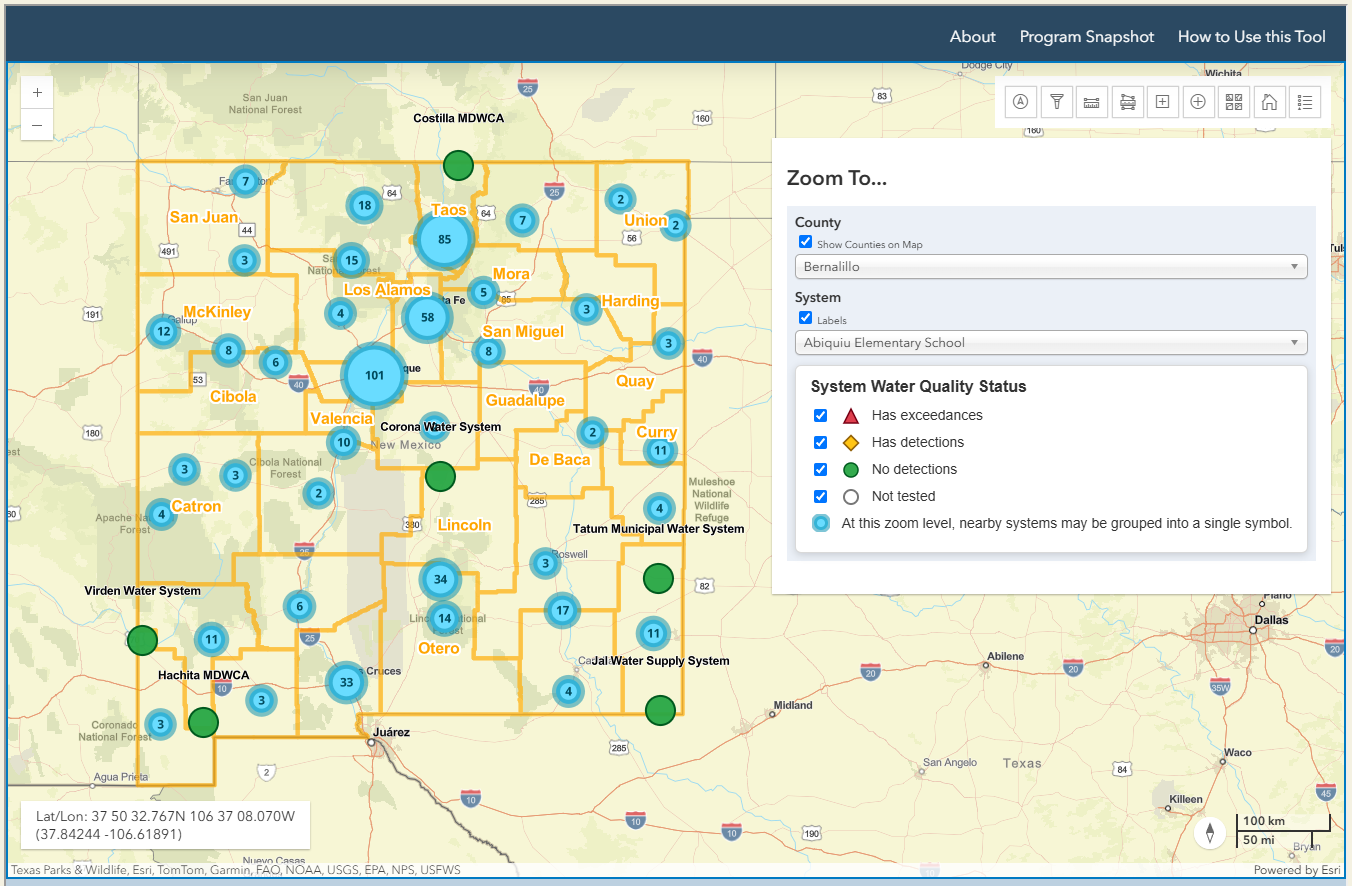
To manage the resulting water quality data, GLA has developed a tailored, web-accessible database management system (DBMS). This online application was developed by GLA to store, visualize, map, manage, and report environmental data.
“This program removes cost and access barriers for small and disadvantaged water systems. We’re giving communities the tools they need to stay informed and confident in their water quality by making this statewide sampling data easily accessible to the public.”
Claudia Trueblood, NMED Emerging Contaminants Program Manager
Results
Integration of the data into the DBMS will enable the ECP to readily map, access, and interact with data through custom queries and analysis tools providing visual and graphic outputs. In addition, New Mexico public water systems, consultants, and other stakeholders can view and download sampling results, and find other contextual information from local, state, and federal spatial datasets. Click here to visit the online database.
Clean, safe drinking water starts with data-driven science and transparent information. By expanding free testing and making results publicly available, we’re helping communities understand emerging contaminants and take action to protect public health.”
James Kenney, Environment Secretary