



Guidance for Seismic Site Response with Pore Water Pressure Generation
Client
National Academies of Sciences, Engineering, and Medicine
Service
Challenge
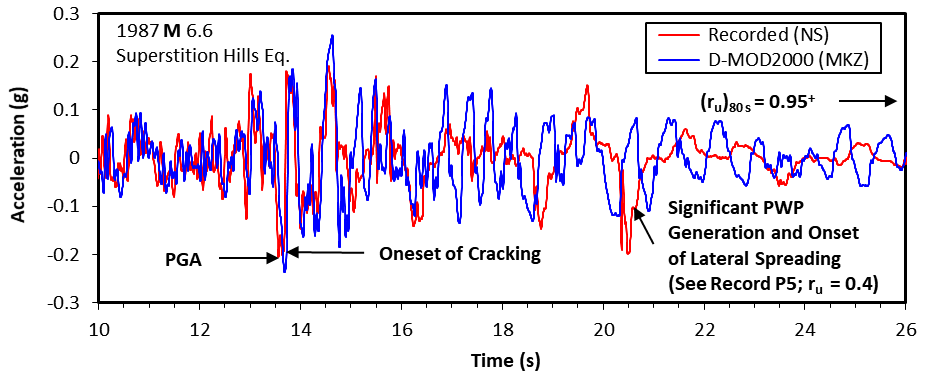
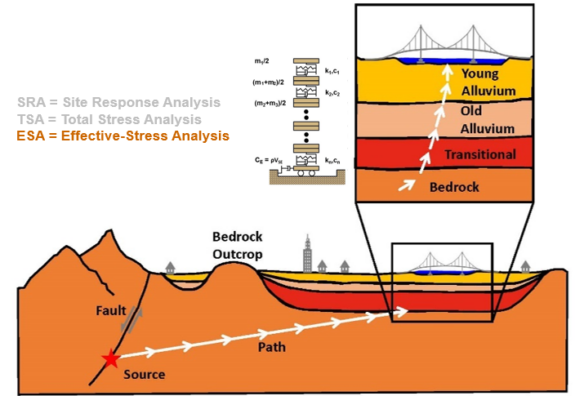
Seismic site response analysis is performed to evaluate the behavior of soil deposits and/or earthfill facilities such as landfills, dams, and heap leach pads when subjected to strong ground shaking. The most advanced version of this analysis is called effective-stress site response analysis because it includes seismically induced pore water pressure generation and dissipation. Effective-stress analysis is now commonly used in engineering practice, yet practical guidance on how to perform and document this type of analysis has been unavailable.
Solutions
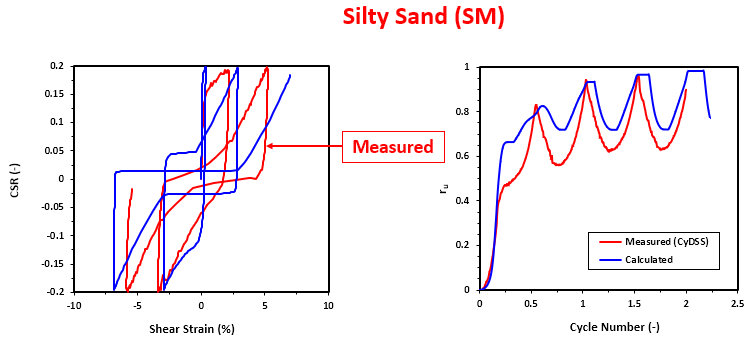
Recognizing a need for practical guidance for effective-stress analysis, the National Academies of Sciences, Engineering, and Medicine (NAS) solicited development of a guidance document (Document) in 2021. The contract was awarded to Geo-Logic Associates with Dr. Neven Matasovic as a Project Manager and Principal Investigator. Services included: (i) assembling of a comprehensive database of effective-stress case histories; (ii) specialty in-situ investigation, sampling, and laboratory testing to supplement data sets for several California case histories; (iii) development of a project-specific geotechnical centrifuge testing program to fill gaps in recorded case histories; (iv) validation of commonly used effective-stress computer programs and constitutive models on selected case histories; (v) numerical simulation of case histories with selected programs and constitutive models; (vi) evaluation of the results; and (vi) development of guidelines on how to develop the effective-stress models, how to validate them, how to properly run and document the analysis, how to interpret the results, and how to review engineering reports documenting these analyses. Work was performed under supervision of an Expert Panel appointed by the NAS.
Results
Our team successfully completed a Guidance Document, which was formally published by NAS in August 2024. In addition to practical guidance, the Document provides answers to several common questions, such as: (i) How accurately can a nonlinear effective-stress analysis program simulate actual phenomena? (ii) What is the proper way to use these programs in engineering practice? (iii) Which site-specific input parameters are required, at a minimum, for analyses (e.g., for site characterizations, constitutive models, seismic loading / input motions etc.)? (iv) What are the capabilities and limitations of commercially available programs and to what extent and for what problems/geosystems have they been validated? (v) What is the process of model setup? and (vi) How should the results of nonlinear effective-stress modeling be interpreted and used? The U.S. Department of Transportation subsequently included our Guidance Document as Chapter 5 in the Geotechnical Engineering Circular 3, commissioned in August 2025. The 10th edition of the American Association of State Highway and Transportation Officials Load and Resistance Factor Design Bridge Design Specifications will be based upon GEC-3.
GLA is proud to have led the development of a practical guidance document that fills a longstanding gap in engineering practice.
— Neven Matasovic, PhD, PE, GE / Principal Investigator and Project Manager