



Tulia 66 Service Station Site Remediation
Client
Texas Commission on Environmental Quality (TCEQ)
Market
Challenge
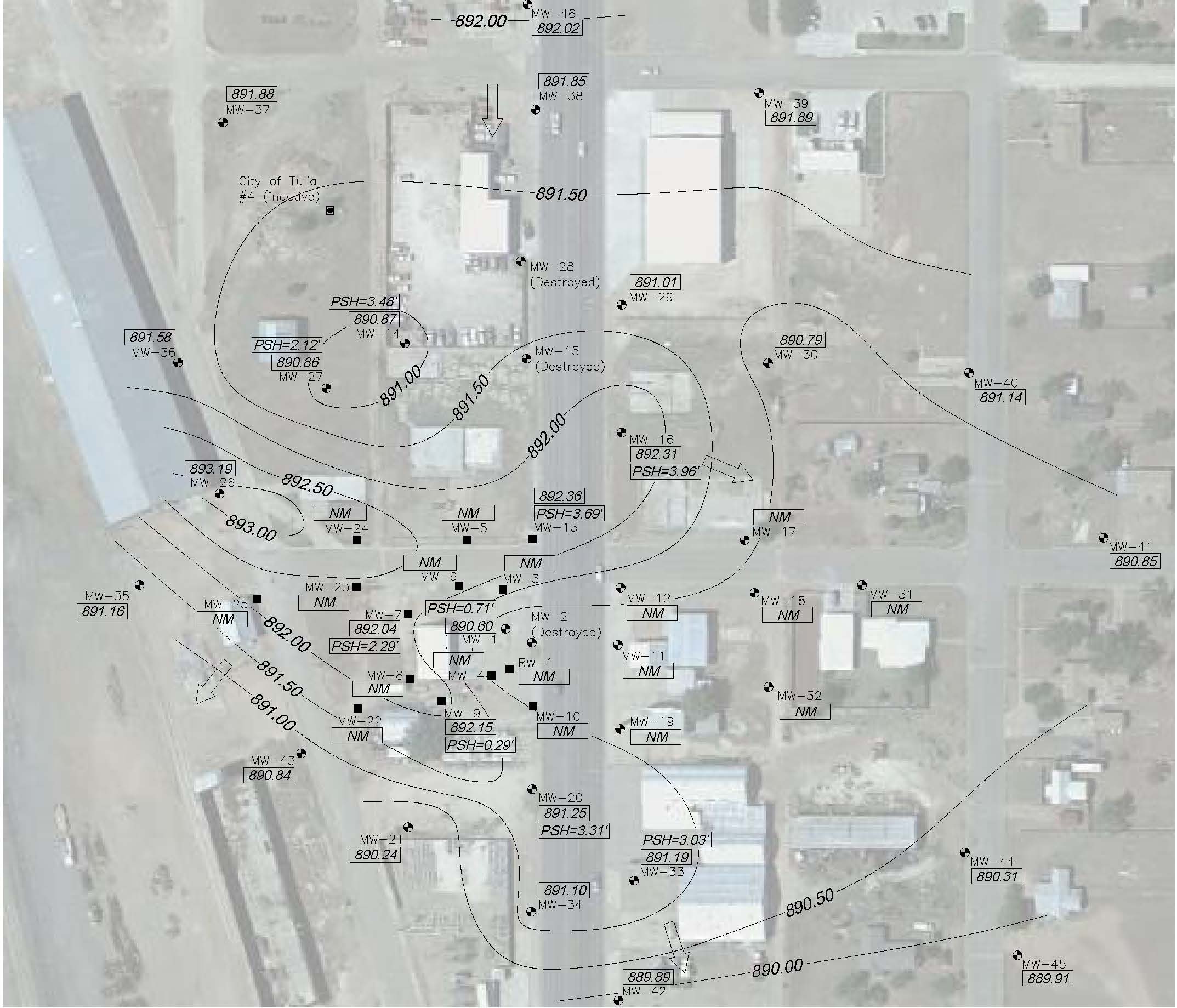
A former retail fuel station in Tulia, Texas, left behind a significant petroleum release that impacted both soil and groundwater above the Ogallala Aquifer—a critical regional drinking water source. Decades of site investigations documented a large non-aqueous phase liquid (NAPL) plume spanning approximately 5 to 6 acres, with product observed in 24 monitoring wells at thicknesses up to 4 feet.
Despite years of remediation using product-only skimmer systems, the plume remained unstable. The site’s hydrogeologic conditions, including groundwater more than 100 feet below ground surface and the extensive footprint of contamination, limited recovery efficiency and threatened long-term corrective action goals established to protect future groundwater users.
Solutions
Geo-Logic Associates applied its remediation engineering expertise to reevaluate site conditions, historical performance data, and available treatment technologies. After reviewing prior dual-phase extraction (DPE) feasibility testing and leveraging lessons learned from similar projects, our team determined that converting the existing West-side skimmer system to DPE would significantly improve mass recovery rates.
Rather than designing an entirely new system, GLA engineered a cost-effective solution by repurposing DPE equipment from another Texas remediation project. We prepared a Corrective Action Plan (CAP) Addendum for TCEQ approval, developed complete design drawings and specifications, screened alternative technologies, and oversaw installation, permitting, utilities coordination, system startup, and performance optimization.
Throughout implementation, GLA successfully overcame significant project challenges, including equipment relocation, inflation-driven construction impacts, utility service interruptions, thermal oxidizer startup issues, and ongoing operation of the neighboring solar-powered skimmer system.
Results
Upon operation, the DPE system immediately demonstrated substantial improvements in NAPL recovery compared to previous remediation methods. Results include:
- Recovery of 9,076 gallons of petroleum hydrocarbons during the first 14 months of DPE operation
- Verification that the historical skimming approach would not achieve remediation objectives within a reasonable timeframe
- Accelerated recovery of petroleum mass and reduced long-term risk to the Ogallala Aquifer
- Establishment of a proven framework for evaluating future conversion of the East-side system to DPE technology
By combining technical evaluation, innovative equipment reuse, and practical field engineering, GLA transformed an underperforming remediation strategy into a highly effective recovery system that is actively reducing contaminant mass and protecting a vital groundwater resource.
“This project demonstrates the value of challenging conventional approaches and applying sound engineering to solve complex environmental problems. By leveraging existing assets, optimizing system design, and focusing on measurable results, we accelerated recovery efforts and delivered a more effective path toward protecting the Ogallala Aquifer. That’s the kind of practical innovation we bring to every remediation project.”
— Todd Seebaum, CAPM - Project Manager