

Geologic Carbon Sequestration: Siting and Feasibility in Basalt Aquifers
Client
Carbon Containment Lab
Markets
Services
Challenge
The Carbon Containment (CC) Lab was exploring the potential for geologic carbon sequestration (GCS) in Washington State’s Columbia River Basalt Group (CRBG) using an approach in which carbon dioxide is dissolved in water to create a carbonated solution that reacts with rock to precipitate solid carbonate minerals when injected underground. The CC Lab needed assistance in understanding where suitable injection zones for GCS may exist in proximity to a sufficient new source of groundwater for carbonation. Regulatorily, carbon dioxide can only be sequestered where 1) total dissolved solid (TDS) concentrations exceed 10,000 milligrams per liter, 2) other groundwater users will not be impacted by a loss of porosity or reduction in groundwater resources, and 3) injected fluid is unlikely to migrate outside the target zone for sequestration. A new water source can only be permitted where 1) water is physically and legally available, 2) The water would be appropriated for a beneficial use, 3) the use would not be detrimental to the public welfare, and 4) the new use would not impair existing water rights.
Solutions
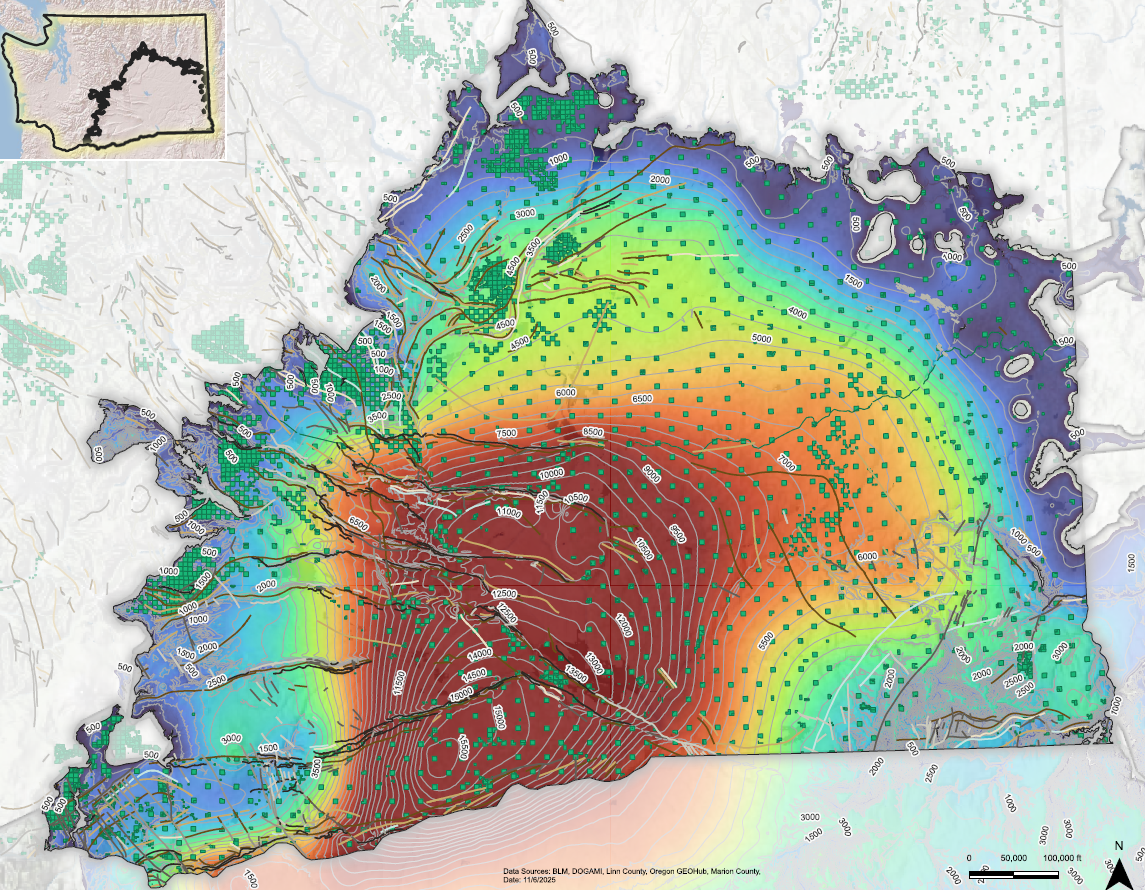
Geo-Logic Associates (GLA) assisted the CC Lab in exploring the potential for GCS in the CRBG by evaluating existing data published by the Washington State Geological Survey and Department of Natural Resources (DNR), the Washington State Department of Ecology, the United States Geological Survey, and the CC Lab to identify potential locations within the CRBG suitable for carbon sequestration. Our team synthesized a wide variety of information, including geologic mapping, geologic and hydrogeologic models of the Columbia Basin, hydro-stratigraphy, water chemistry (including TDS), and well yield data to identify suitable GCS injection zones and potential source water aquifers. We also evaluated groundwater management areas, density of groundwater users and existing well depths, preferred land ownership, and cultural resources to identify the most feasible locations.
Results
GLA identified three locations where CRBG aquifers are likely to meet the criteria needed for a successful GCS project, including adequate water availability and suitable injection zones that are least likely to adversely impact groundwater users. These locations best met GCS regulatory criteria by demonstrating elevated TDS concentrations at depth, suitably permeable and transmissive zones for injection, hydraulic compartmentalization (which minimizes potential migration of injected fluids), and low density of other nearby groundwater users.